With $3.5 million in funding from the GI Research Foundation, a team at the MD Anderson Cancer Center explores a one-two punch to combat BRAF-mutated colorectal cancer and its “dismal prognosis.”
CHICAGO, December 13, 2023 (Newswire.com)
– Many cancers caused by the mutation of the BRAF gene respond well to a class of immunotherapies known as BRAF-inhibitors. BRAF-mutated colorectal cancer, however, almost never does. Doctors have known this for years, but they are yet to find a treatment that works well for most patients.
“BRAF-inhibitors provide very different clinical outcomes,” said Dr. Scott Kopetz, a Professor and Associate Vice President for Translational Integration at The University of Texas MD Anderson Cancer Center. “They work amazingly well in melanoma, for example, but are less effective in colorectal cancer.”
“BRAF [in colorectal cancer] is that odd uncle who doesn’t behave like the rest of the family. The black sheep. Is he even related? The usual rules don’t apply.”
Dr. Kopetz and his team’s most recent studies of this black sheep are now moving from research in mice to clinical trials in humans. These trials were approved by the National Cancer Institute in October and will launch in early 2024.
The GI Research Foundation helped support the work with mice models, along with several other aspects of the team’s BRAF-related research. The $3.5 million grant is part of the foundation’s massive CA CURE initiative.
“Last year, we were able to deliver more than $18 million to researchers across the country to improve diagnostics and develop immunotherapies and personalized vaccines in gastrointestinal cancers through CA CURE,” said Katie Chudnovsky, chair of the GI Research Foundation’s Board of Directors. “Patients need treatments like those being developed by Dr. Kopetz – so very urgently – and we are thrilled to see this team’s work moving to clinical trials so quickly.”
BRAF-mutated colorectal cancer comes with a “dismal prognosis,” according to research in the International Journal of Molecular Sciences, and the median patient survives less than a year.
This new form of treatment for BRAF-mutated colorectal cancer relies on what Kopetz called a “two-hit hypothesis.” That is, these cancers are caused by the combination of mutations in the BRAF gene and epigenetic dysregulation. Epigenetic dysregulation refers to the fact that behaviors and environment can impact how a person’s genes behave.
Here, researchers have found that a mutation to the BRAF gene changes the production of proteins that cause healthy cells to grow into cancerous tumors. Other forms of BRAF-mutated cancer respond well to BRAF-inhibitor immunotherapy that can halt the production of those proteins.
In BRAF-mutated colorectal cancer, however, another piece of DNA is unable to express itself entirely. Those genes typically create natural tumor suppressors that fight early cancer growth. Carbon molecules called methyl groups attach themselves to the DNA and prevent the DNA from building cancer-suppressing proteins. That “methylation” is the epigenetic dysregulation in this case, likely caused by inflammation, diet, or external environmental factors.
If doctors can stop the proteins that cause cancer and stop the bromodomains, they might be able to produce a one-two punch to combat their double hit hypothesis. The treatment would slow BRAF-mutated colorectal cancer growth and encourage natural cancer suppressors.
That idea will be tested in the human trials that were recently approved by the National Cancer Institute. A BRAF-inhibitor, an EGFR-inhibitor, and a bromodomain-inhibitor will be administered to patients. This combined treatment was developed by Kopetz and his colleague Dr. Kunal Rai, an Associate Professor of Genomic Medicine at MD Anderson.
The research moved from the GI Research Foundation-funded mouse models to human trials exceptionally quickly, according to Kopetz.
“It’s rare for the pieces to come together like this,” he said. “Lots of times, this would be two years of work to get the human trials up and running. But we were able to show how clearly this approach worked in multiple mouse models and that really sped things up.”
Other funding from the GI Research Foundation will help speed things up even further. “The new technologies and techniques that Dr. Kopetz and his team are exploring will give them the ability to innovate that much faster. It provides the entire community with the means to gather high-quality data more quickly and get it into trials and ultimately into the clinic,” said Dr. David Rubin. Rubin is the Joseph B. Kirsner Professor of Medicine and Chief of the Section of Gastroenterology, Hepatology and Nutrition at University of Chicago Medicine. He is also GI Research Foundation’s Senior Scientific Advisor.
“The GI Research Foundation has a legacy of funding high risk-high reward and innovative science, and doing so efficiently and extraordinarily effectively. Kopetz and his colleagues were recipients of a dedicated campaign that we launched in 2022 to tackle the most difficult challenges of colorectal cancer.”
“Support from the GI Research Foundation allows us to accelerate our work and try some out of the box stuff,” Kopetz said. “We have amazing animal models, but there’s no substitute for understanding cancer and treatments with the patients themselves. We want to develop the tools we need so we can learn as much as possible from them and help them as much and as quickly as we can.”
About the GI Research Foundation
The GI Research Foundation was founded in 1961 by grateful patients and friends of the late Dr. Joseph B. Kirsner, a pioneer in gastroenterology who devoted his life to medicine, teaching, and patient care. Today, the University of Chicago Medicine’s Digestive Diseases Center, which is supported by the foundation, is internationally recognized for research-driven medicine and its team of highly specialized physicians. For more information, see: https://giresearchfoundation.org/
About the University of Chicago Digestive Diseases Center
The Digestive Diseases Center at the University of Chicago Medicine is a collaborative, multidisciplinary network of physicians, researchers and affiliated health professionals who share a legacy of innovation and a common purpose: to improve the lives of patients who suffer from digestive diseases. For more information, see: https://www.uchicagomedicine.org/conditions-services/digestive-diseases
Preventogen’s FDA-Cleared Microbicidal Liquid Polymer Ensures the Eradication of These Dangerous Pathogens on Contact While Forming a More Effective and Measurable Barrier to Optimize Healing
Exclusive partnership provides a complete, end-to-end value-based care delivery, payment model and advanced analytics solution for payers, providers, payviders and large employers to improve quality, cost control, heal…
OnPage Announces Enhanced Integration With Slack to Empower Healthcare Teams With Unparalleled Critical Alerting and ‘Paging’ Capabilities Directly From Slack
WALTHAM, Mass., December 12, 2023 (Newswire.com)
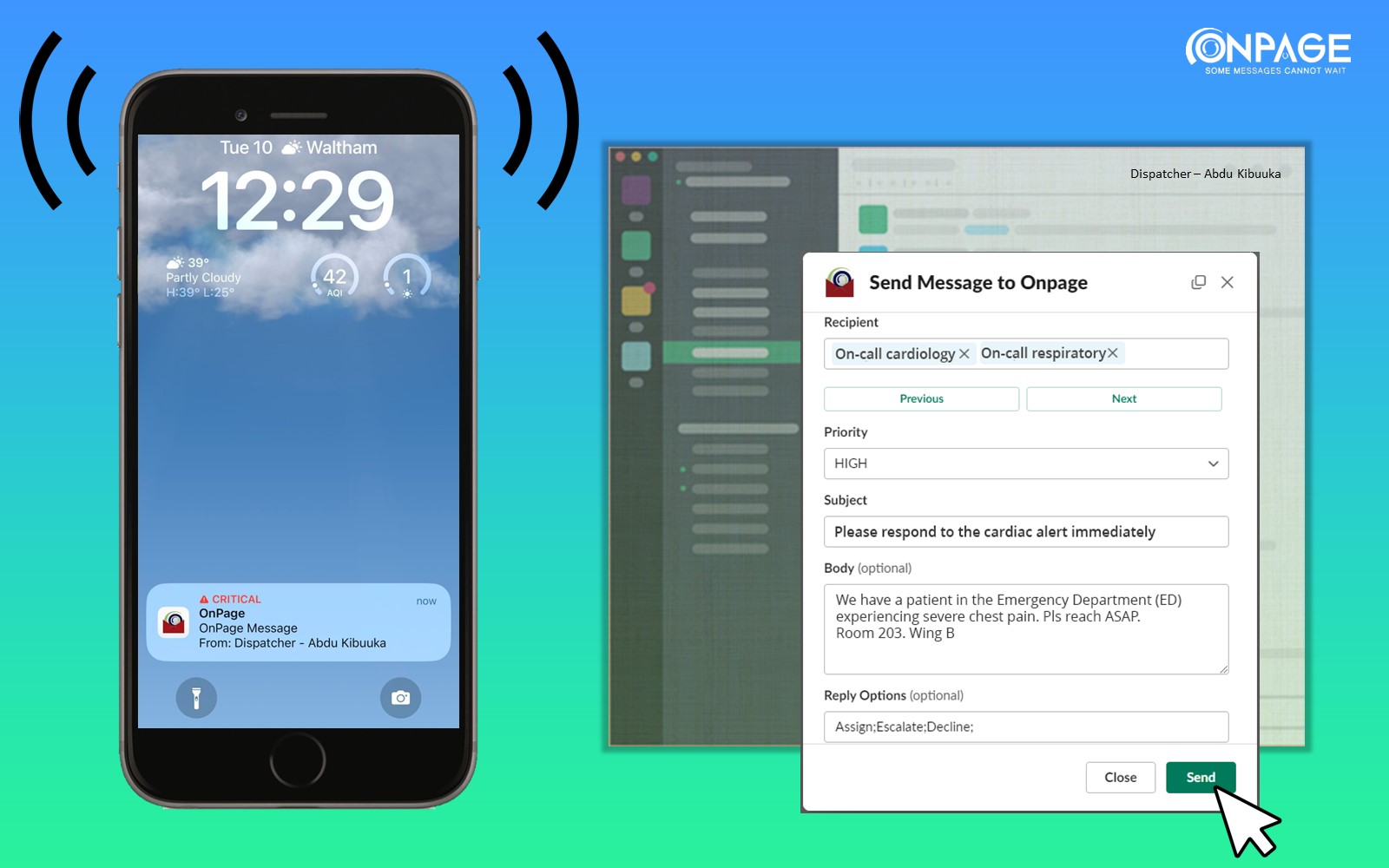
– OnPage, a leading provider of a HIPAA-compliant secure messaging platform, is proud to announce the launch of its new integration with Slack, marking a monumental breakthrough in healthcare communication technology. This groundbreaking integration with Slack is set to redefine the landscape of critical messaging within healthcare organizations.
With healthcare’s increasing need for secure and efficient HIPAA-compliant communication, the integration between OnPage and Slack emerges as a game-changer. This integration isn’t just an upgrade; it’s a transformative shift that ensures every critical moment in healthcare is addressed with precision and immediacy.
Slack, a widely recognized collaboration and intelligent productivity platform known for its robust security features, enables customers to configure their Slack instance to meet their HIPAA compliance needs. For Enterprise Grid customers, Slack offers encryption at rest and in transit, two-factor authentication, session management, and mobile device management, making it a trusted choice among healthcare providers.
Slack’s collaboration and productivity capabilities, coupled with OnPage’s critical messaging, accountability, real-time responsiveness, on-call scheduling, and escalation capabilities, will provide healthcare teams with a single, dedicated space for urgent alerts and eliminate the risk of crucial information getting lost in day-to-day communication.
Accommodating schedules, shifts, and escalation policies in critical events is paramount in healthcare. OnPage’s robust scheduling capabilities seamlessly integrate with professionals’ shifts, ensuring that critical messages reach the right individual at the right time on their OnPage phone application. Additionally, customizable escalation policies within OnPage guarantee that if an urgent message remains unacknowledged for a specified period, it automatically escalates to the next responsible personnel, ensuring no critical matter goes unattended.
The integration is undergoing a pilot phase at a major healthcare organization, enhancing communication among healthcare providers, dispatchers, and EMT staff without disrupting workflow.
Key features include seamless critical message exchange, leveraging OnPage’s scheduler and escalation capabilities, acknowledging and responding to critical messages within Slack, and access to a comprehensive message audit trail.
“We are thrilled to introduce this groundbreaking integration between OnPage and Slack. This collaboration empowers healthcare professionals with a solution that bridges communication gaps, ensures real-time responsiveness, and revolutionizes critical messaging within healthcare organizations,” said Judit Sharon, CEO of OnPage.
The integration enables swift care team mobilization, facilitating timely alerts to providers and fostering a culture of accountability. Comprehensive visibility empowers senders to track message delivery and intervene promptly if needed.
The OnPage and Slack integration is poised to reshape critical messaging in healthcare, bringing unparalleled efficiency, fostering accountability, and ensuring real-time responsiveness — an advancement in how healthcare professionals engage and respond to urgent moments.
About OnPage
OnPage is an Incident Alert Management platform that elevates critical notifications to the right person on call to remediate critical events. With Alert-Until-Read capabilities, dynamic digital schedules, escalation criteria and redundancies, OnPage ensures that critical alerts are never missed. Learn more.
 Formulator Lindsey Duncan, CN, ND, notes this is not just another trendy coffee upgrade but a true coffee revolution in taste and health benefits.